
Leading Questions in Surveys: How They Influence Results
by Gotham Polling
Understanding How Question Design Shapes Survey Responses
Surveys are one of the most valuable tools for understanding public opinion, measuring attitudes, and collecting reliable data. Whether organizations are conducting voter research, community assessments, customer studies, or policy evaluations, the quality of the insights depends heavily on the quality of the questions being asked.
A survey does not simply collect answers. It creates a framework through which respondents interpret and provide information. Even small differences in wording can influence how people understand a question and how they choose to respond.
This is why avoiding leading questions in surveys is essential for producing accurate, balanced, and trustworthy results.
At Gotham Polling and Analytics, careful questionnaire design is a key part of conducting reliable research. By focusing on neutral wording, thoughtful methodology, and representative sampling, organizations can gather insights that accurately reflect the perspectives of their target audiences.
What Are Leading Questions in Surveys?
A leading question is a survey question that is written in a way that encourages respondents toward a particular answer. Instead of allowing individuals to provide an independent opinion, the wording may introduce assumptions, suggest expectations, or influence how the respondent views the issue.
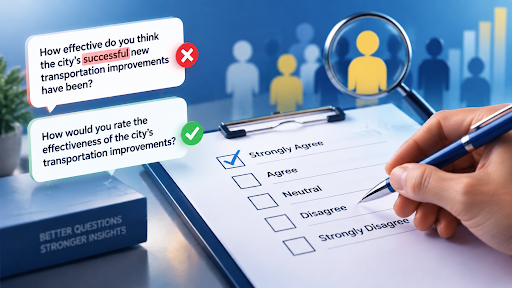
For example, consider these two questions:
Leading question:
“How effective do you think the city’s successful new transportation improvements have been?”
Neutral question:
“How would you rate the effectiveness of the city’s transportation improvements?”
The first question includes the word “successful,” which creates a positive assumption before the respondent provides an answer. The second question allows the respondent to evaluate the issue independently.
The difference may seem minor, but question wording can significantly affect survey results, especially when measuring public opinion on important topics.
Why Question Wording Matters in Polling
Survey question bias is equally important and crucial as any other factor in pollings. Survey participants respond based on the information presented to them. When a question contains emotionally charged language, assumptions, or incomplete framing, it can unintentionally influence responses.
This is known as survey question bias.
Question wording can impact results in several ways:
1. Creating Positive or Negative Associations
Certain words carry emotional meaning. Terms that suggest approval or criticism can influence how respondents interpret a topic before answering.
For example, describing a program as “beneficial” or “costly” may lead respondents toward different conclusions, even when asking about the same subject.
Professional polling requires carefully selecting language that allows respondents to express their own views rather than reacting to the language used in the question.
2. Introducing Assumptions
Some questions contain assumptions that may not apply to every respondent.
For example:
“Why do you think residents are dissatisfied with current services?”
This question assumes dissatisfaction exists. A more neutral approach would be:
“How satisfied or dissatisfied are you with current services?”
The revised question gives respondents the ability to provide a wider range of opinions.
3. Limiting Available Perspectives
Poorly designed questions may not provide response options that accurately represent how people think about an issue.
A balanced questionnaire should include options that allow respondents to express different levels of support, uncertainty, or lack of opinion.
This is particularly important in public opinion research, where understanding the full range of perspectives is more valuable than forcing responses into limited categories.
The Role of Questionnaire Wording Effects
Questionnaire wording effects refer to the ways that the structure and phrasing of survey questions can influence the answers collected.
These effects can occur through:
- The words used in a question
- The order of questions
- The response options provided
- The context surrounding the question
For example, asking respondents about a specific concern before asking for their overall opinion may influence how they evaluate the broader issue.
Experienced researchers consider these factors during survey development to ensure that results reflect genuine opinions rather than reactions to question design.
How Professional Polling Avoids Leading Questions
Creating unbiased polling questions requires a structured approach. Researchers typically review surveys carefully to identify language that could unintentionally influence responses.
Some best practices include:
Use Neutral Language
Questions should describe topics objectively without suggesting whether an answer is positive or negative.
Instead of:
“Do you support the unnecessary increase in government spending?”
A neutral version would be:
“Do you support or oppose the proposed increase in government spending?”
Avoid Emotionally Charged Terms
Words that create strong emotional reactions can affect responses. Neutral terminology helps respondents evaluate issues based on their own understanding.
Provide Balanced Response Options
A well-designed survey should allow respondents to express different viewpoints. Options such as support, opposition, neutrality, or uncertainty can provide a more accurate representation of public opinion.
Test Questions Before Launching Surveys
Survey testing helps identify potential issues with wording, interpretation, or response patterns before collecting final data.
This process improves reliability and ensures that the results provide meaningful insights.
Leading Questions and Political Polling
In political polling, question neutrality is especially important because public opinion research often examines complex issues where individuals may have different experiences and priorities.
Reliable polling does not attempt to guide respondents toward a specific outcome. Instead, it aims to measure opinions accurately by using transparent methods and carefully designed questions.
Understanding how political polls work requires looking beyond the final numbers and considering factors such as sampling methods, question design, and data collection practices. As discussed in previous Gotham Polling & Analytics research, including How Do Political Polls Work? and How Accurate Are Political Polling Methods?, methodology plays a critical role in producing trustworthy results.
The Importance of Unbiased Survey Design
Every survey question represents an opportunity to gather meaningful information. When questions are carefully designed, organizations can better understand public attitudes, identify trends, and make informed decisions.
Whether conducting community research, evaluating programs, studying consumer preferences, or analyzing voter perspectives, unbiased survey design improves the credibility of the findings.
Avoiding leading questions is not simply about following a technical standard. It is about respecting respondents and ensuring that collected data represents their views accurately.
Final Thoughts
Leading questions in surveys can unintentionally influence responses and reduce the reliability of research findings. Through careful questionnaire design, neutral wording, and thoughtful methodology, organizations can minimize bias and collect more accurate insights.
High-quality polling depends on more than asking questions. It requires asking the right questions in the right way.
By prioritizing unbiased polling questions and transparent research practices, organizations can better understand the communities, audiences, and stakeholders they serve.