

Political Poll Sampling: How Polls Represent Voters
by Gotham Polling
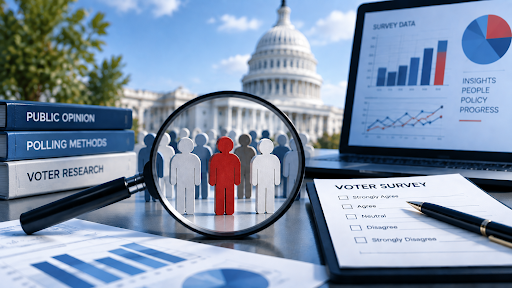
Political polls are designed to provide insight into public opinion, but the accuracy of those insights depends heavily on one important factor: the quality of the sample being surveyed.
Because it is usually not practical to ask every voter for their opinion, polling organizations use sampling methods to collect responses from a smaller group that reflects the larger population. When done correctly, this process helps researchers understand broader trends, preferences, and perspectives.
Understanding how poll sampling works provides valuable context when evaluating survey results and interpreting public opinion data.
What Is Political Poll Sampling?
Political poll sampling is the process of selecting a group of individuals to participate in a survey with the goal of representing a larger population.
For example, instead of surveying every registered voter in a state or region, a polling organization may select a smaller group that reflects the characteristics of that voting population. These characteristics may include factors such as age, geographic location, education level, and voting history.
A well-designed sample allows researchers to identify patterns and measure public sentiment while maintaining efficiency and accuracy.
Why Does Sample Representation Matter?
A poll is only as useful as the people included in the survey. If certain groups are overrepresented or underrepresented, the results may not accurately reflect the broader population.
Representative sampling helps reduce these challenges by ensuring that the surveyed group aligns with the population being studied.
For example, if a survey about voter opinions includes responses from only one demographic group, the findings may provide an incomplete picture. A properly designed sample considers the diversity of the population and creates a more balanced view of public opinion.
Common Political Poll Sampling Methods
Polling organizations use different approaches to gather survey responses. The appropriate method depends on the goals of the research, the population being studied, and available resources.
Random Sampling
Random sampling gives individuals within a population a known opportunity to be selected for a survey. This approach helps reduce selection bias because participants are not chosen based on specific characteristics or preferences.
Random sampling has long been an important foundation of survey research because it creates a structured way to collect responses from a broader population.
Stratified Sampling
Stratified sampling divides a population into specific groups, or segments, and then selects participants from each group.
This method helps ensure that important characteristics of the population are represented within the sample. For example, researchers may create segments based on geographic areas or demographic factors before selecting respondents.
Online and Panel Sampling
Many modern polls use online survey panels, where participants are recruited in advance and invited to complete surveys.
These methods can provide faster access to respondents, but researchers must carefully manage recruitment and weighting processes to maintain representative results.
How Pollsters Improve Sample Accuracy
Creating a representative sample is only one part of producing reliable survey results. Pollsters also use additional techniques to improve accuracy.
Defining the Target Population
Before conducting a survey, researchers must clearly define who the poll is intended to represent. This could include registered voters, likely voters, residents of a specific area, or another defined group.
A clear target population ensures that survey findings are interpreted within the correct context.
Considering Sample Size
Sample size affects how much confidence researchers can place in survey results. Larger samples generally provide more information, but sample quality remains just as important as the number of responses collected.
A carefully designed smaller sample can provide meaningful insights when it accurately reflects the population being studied.
Applying Data Adjustments
After collecting responses, researchers may apply statistical adjustments to account for differences between the sample and the broader population.
These adjustments help align the survey results with known population characteristics and improve the overall reliability of the findings.
The Role of Sampling in Understanding Public Opinion
Sampling allows researchers, organizations, and decision-makers to better understand community perspectives without surveying every individual.
From measuring public attitudes to studying voter priorities, carefully designed samples provide a practical way to analyze trends and identify changes in opinion over time.
As discussed in previous discussions about how political polls work and how sampling techniques impact political poll accuracy, the methods behind collecting and analyzing responses play a critical role in producing meaningful insights.
Understanding Poll Results Beyond the Numbers
When reviewing polling data, it is important to look beyond the headline numbers. Factors such as sampling methods, survey design, respondent selection, and methodology all influence how results should be interpreted.
A transparent approach to sampling helps audiences better understand what a poll measures, who was surveyed, and how the findings can be applied.
Reliable polling is not simply about collecting responses. It is about creating a research process that accurately reflects the voices and perspectives of the population being studied.